
FA
Financial Advisers
Indexing
Sifting through hundreds of thousands of hours of indexed videos
Financial Advisers
Sifting through hundreds of thousands of hours of indexed videos
Financial Advisers
Arcmira media summary
Explore podcasts, interviews & explainers on financial advisers — 2 indexed from Future Proof, updated Oct 2025.
Why do financial adviserss work with Franklin? What is it about your firm's culture that makes you guys special and makes you guys stand out? First of all, I have to take my sunglasses off because I don't think you trust anybody with your We're all taking off the glasses. We're all taking off. But I've been filming you on my meta glasses. Okay. So, you're all on there. Um, look, you know, I mean, so my grandfather started Franklin Templeton and uh, he started Franklin Templeton at a time because the average person couldn't get access to the stock market. So he started out in the mutual funds and you know that was the creation that gave everybody really the democratization of access. And so I think in our roots we have been um, a firm that is built around the financial adviser and working with financial adviserss. And today uh we're 1.7 trillion. We have 260 billion alternatives. So we have a broad platform of capabilities. Uh we're I think the seventh largest alternatives manager. Um and why do advisers like to work with us? Because I think you can trust us. I mean that that you know people when we look at our brand and have asked about our brand, trust comes up as the number one kind of factor with that. Um, and I say we've done 11 acquisitions in the last five years. Um, so, uh, Lake Mason, Lexington Partners, Clarion Partners, Benefit Street Partners, a bunch of brands. Uh, and the a lot of times people will ask, well, how do you deal with the fact that you're bringing in different cultures? And I always say it's the three C's that we look for. It's amazing when you're doing due diligence on a company how quickly the management team starts talking about clients. Because if they don't start talking about clients pretty early, they're actually never going to be focused on that something that you'll actually listen for. Absolutely. Okay. I mean, it is amazing how quickly you can kind of see what people's priorities are. So, one is clients. The second is collaboration, which usually you can see and how well they work with each other and kind of like each other, right? Uh I remember doing a uh we were looking at an investment in a company and we were pretty far along in it and finally I ended up meeting the investment team and I turned back to my team after I said you guys realize like these two owners don't actually like each other like you can see it in the room and sure enough we had already done the investment and it ultimately went to zero. So, I don't know whether that was a factor or not, but um it matters and and when you're bringing them into another organization, if they already don't collaborate with each other, they're not going to collaborate more broadly in the firm. And so, we don't want to be a firm with a bunch of managers. We want to be a firm that you actually get benefits by having capabilities. Um I was having a conversation with our private credit guy. He spends a lot of time with our secondary PE Lexington partners talking about building relationships with sponsor firms. It helps him in his origination. Um so it's that kind of collaboration. And the third se is a mindset of continuous improvement. And look in my 30 plus years in this industry, there has been no time that has had the pace of change that we are experiencing now. And and most of the change is technologies that have been existing out there for decades. Cloud computing, others. We haven't even scratched the surface on how AI is impacting our industry and how blockchain is going to impact our industry. And so if you don't have a mindset in an organization of trying to find ways to improve, you are going to be left behind. Our clients are asking more and more of us every day. I would imagine it's the same thing in your industry that your clients, us, the adviserss are asking you to do more. 100%. I mean, they they rarely say, "Hey, what's your latest large cap value fund?" Right? They're like what else can you do to help me? And so we built a lot of technologies around that to support the practice management of advisors. Um obviously you know we we did an acquisition of of canvas which started out kind of direct indexing but it actually um has option overlay. It has a lot of ways in which you can customize because your clients are asking you to customize for them. Uh and so we're providing those kind of tools to help do that. So, it strikes me that um one of the big waves that we're seeing in the RAA space and probably also at the wires and the independent broker dealers is that advisors are increasingly looking for firms to work with that can offer them an entire suite versus just one specific not only strategy but even like uh mutual funds, SMAs, they want somebody to also be in the TAMP. I think as advisers try to serve more types of clients and try to standardize what they're doing, having fewer asset management partners is probably the wave. And I'm curious if you if you guys think about that when you're looking at acquisitions or new lines of business that you might start. 100%. I mean, you consistently hear that because it's gotten more and more complex, right? I mean, you know, again, your clients are asking for personalization. they're demanding much more of you and so one of the ways to reduce your complexity is to work with fewer managers who can do more for you. So we definitely see that trend. Uh and you know let's face it the due diligence you have to do on a one firm is whether it's a small firm or a big firm it's kind of the same element of of firm due point. You have to do the same amount no matter what. Exactly. So if you can get a firm that can provide you broad breadth of capability and then you can demand more because you have more assets with them. So, you know, what additional services are you providing? We're getting a lot of um, you know, questions around like alternatives and no advisor needs to be convinced that they should have alternatives in portfolios to their clients. Their questions are around how should I think about it? How should I do portfolio construction? And so, we've built a whole academy that's just focused on helping advisers do um, you know, think about portfolio construction with alternatives. So, it's those types of things that scale enables you to do. And then I am a I absolutely believe that if you are an asset manager and you don't have scale in this world of AI, you are going to be left behind because you will not have the data to train your models. You're just not going to have enough. How are you thinking about scaling your business, servicing your advisor clients, uh keeping your shareholders happy, all within the context of two back-to-back 20% years in the S&P? The wind has been in our backs for a long time now and at some point the tide will go out. So how do you think about going going investing and growing while managing the risk for your shareholders and your employees? Yeah. Well, first of all, my father always said take care of the client, the business takes care of itself. So he's one focus, right? What do right for the client and I and he lives it. At one point we had a bank and I ran this credit card department. We'd done a little acquisition and there was a way to interpret some of the contract that allowed us to kind of go in and get excess I can't even remember some additional fees or something but it was probably not intended at the time. So I remember I was you know in my 20s and I said to my dad what do you think about this and he just looked at me and he goes listen I don't know the details but I can tell you something if you blow your reputation you never get it back. So you do what's right you treat people well and you focus on the client. So I think that that first of all is just a you know when you talk about all those constituencies focus on the client. So that's one and then I say you know the um you you if you are listening to what the client's needs are you're trying to bring those types of capabilities. So from an investment you talked about all those different vehicles. We think that what we bring to the table is our investment management expertise right and risk adjusted turn active managers have to f focus on risk adjusted returns and so in 20 plus% markets sometimes you have to you you will underperform the benchmark because you have to consider concentration risk and when you have a series of stocks that are so heavily concentrated you have to decide do I want to underweight the benchmark or am I okay with that risk right so there's that's that kind of conversation when you're having with advisors and communicating with advisors. So expectations are appropriate and then the key is we got to be transparent about the risks of our products because as advisors you've got to make sure you understand your client's risks appetite and so that the products have to be appropriate for those risk appetite. So we've seen huge wave of innovation in asset management. I know it's always that way but over the last 5 to 10 years it really does feel like it's been speeding up. It's been accelerating. I wanted to ask you, is there any type of product or suite or approach that you guys chose not to pursue that you now regret? Is there anything you missed whether uh more active ETFs or leverage ETFs, single stock ETFs? Are there any thematic ideas that you guys didn't jump on that maybe now you say maybe we should have? And then are there any categories where um you feel that there's still an opportunity in the marketplace that's not being served and you guys might have the ability to do something uh much bigger there than other players? Like how do you think about all that evolution and where you guys fit in? Yeah, I remember I mean I and you can bash any of your competitors. They're not listening. They're all in the breakthrough tent right now. So Okay. Um, no. I mean, I have to be honest, like you you you think about you want to have vision where you believe things are going. I mean, honestly, somebody brought one of the big direct indexing platforms to me saying, "Hey, they're looking for some investment in there. I think they were 100 million. They're now multi multi-billions today." And I was like, "No way. That'll never take off." I know. I know the feeling. there are still people that that believe that and and you know we were uh we were early on active ETFs but probably late on passive ETFs and I don't think we had the vision about how the passes would be used in kind of model portfolios early on you know so you never get it fully right and I think the most important thing is to say okay you know let's take a look at that think about what our rationale was on the decision-making at the time and did it make sense and you know you you Where where are the areas that you guys currently are most focused because you think they could be the next big thing? Well, I think there's no question that alternatives to the wealth channel is going to be the next big wave. And every alternatives manager is focused on the wealth channel, which brings some concerns to me, which I'll talk about in a second. Um, because they have probably saturated much of the institutional market, right? So, if they're going to justify multiples and be able to grow, they look at the wealth channel. So you know and if you if you think today um only 13% of companies who have revenue of 100 million or greater are actually publics. There's you know just over 4,000 public companies. There's 17,000 plus companies with 100 million or more revenue. So you know your average investor who's not investing in the in the private markets right is not getting access to 87% of those opportunities. And so it's a natural, but the question is how do you bring it appropriately? Areas that I am passionate and I think there's huge opportunity on. I love secondary PE. There's been $6 trillion deployed in private equity. The realizations are a half of what they were before. In other words, these institutions who counted on the cash flows coming to make their next allocations in investments, private markets, are seeing half of what they saw before. And so they're having to clear out their balance sheet. Uh and so they sell them to a secondary manager. And you take Lexington Partners, I mean, their their current fund 11 I think is lights out as far as uh the discounts they get. But they buy these portfolios at discounts. And so here's a real transaction. Uh uh state pension says I need a billion dollars out of my portfolio in 30 days. So you go in as a secondary manager and say, you know, I'll take that fund, that fund, and vintage over here. So you get to to literally kind of cherrypick which ones you want. Uh and and then you negotiate a discount which immediately occurs to your investors. And so I love the secondary space because of the amount that's been deployed in private equity. Is the right way to think about secondaries that it's private equity investing but potentially derisked to. I mean, look, you're getting a diverse portfolio because there's multiple vintages from different firms in there. You have no J curve because the average age of a uh secondary portfolio that you buy is 5 years old. And um the average uh PE fund didn't start paying cash flows out to year eight, which can be really hard for, you know, your average investor. And so now they only have to wait three years and they start getting cash flows. Okay. Uh so to me, it's the best way for the wealth channel. I actually even personally love it. I think for institutions are now loving it because they love that discount. So Franklin has your roots in public markets. Lexin Partners is a company that you just mentioned. You own them. You're also a top 10 provider in private markets. When did you all start making the move into that area? So we bought Benefit Street Partners which is private credit manager and and they're about 82 billion I think today uh in 2018. So that's when we first made the move and then we got Clarion Partners which is a real estate manager as part of the LegMason acquisition and then uh bought Lex Lexington Partners a couple years ago. We interestingly the only real organically grown alternative manager um you know private markets alternative manager was our our venture group and it's because the Franklin equity team which is housed in Silicon Valley they're sitting there looking at attribution and they're like we're not getting the IPO kickers that we used to get because these companies are waiting so long to go public we can have up to 15% allocation and so they started to do latestage venture so you can have up to 15% a mutual fund in in private rivate market. So they did late stage venture and interesting in many ways some of their best deals were deals they didn't do because they're embedded in they're the only VC fund I'm aware of that's embedded in a public market equity fund uh team and so they'd look at it and say well the VC guys are convincing them of this price but if you look at the public market valuation it just doesn't justify the price and so it was deals they stayed out of um but you know they're they're in Silicon Valley so their kids are going to school with all these uh entrepor reneurs and others and so they've done very well. You are the granddaughter of the founder but you started your career in the mail room. So can you tell us your Horatio Alger rags to rich's story. Well, I I did start in the mail room stuffing envelopes for money market funds because in the 80s that was like, you know, this nobody could keep up with that and so late 70s in the 80s. I was I think I was like 14, but maybe I was 16. I don't know whether what was legal at the time. My dad just looked at me. He goes, "Well, go get a job somewhere else." I love it. That was what I learned. Good lesson. Good lesson. Jenny, we uh we told people that we were interviewing you today. I have to tell you something. Every single person that I told that's in the industry, hey, we have Jenny Johnson on stage. Every single person says the same thing about you. She's awesome. She's That's your reputation. Um, so I want to just say thank you so much for being part of this. You are awesome. Uh, how about a round of applause for Jenny Johnson? Thank you. Thanks for having me.
Now, all of you here, you're financial adviserss, you support adviserss, you invest in adviserss,
Arcmira tracks 2 indexed media appearances or mentions for financial advisers, tied to source videos, channels, and transcript-derived context.
Arcmira uses indexed YouTube videos and transcripts. Representative source evidence on this page includes "The Compound and Friends Live: Jenny Johnson on Leadership, Growth and the Future" with transcript-derived context and links when available.
financial advisers is connected to Apple, AI, Spotify in Arcmira's media graph.
2
Mentions
55
Views
The trendline is visible, but the dated evidence behind financial advisers is in the premium layer.
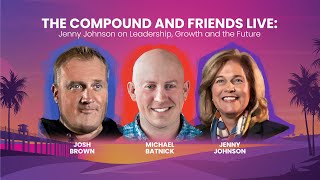
“Why do financial adviserss work with Franklin? What is it about your firm's culture that makes you guys special and makes you guys stand out? First of all, I have to take my sunglasses off because I d...”
“Now, all of you here, you're financial adviserss, you support adviserss, you invest in adviserss,”