
PS
Program Synthesis
Indexing
Sifting through hundreds of thousands of hours of indexed videos
Program Synthesis
Sifting through hundreds of thousands of hours of indexed videos
Program Synthesis
Arcmira media summary
Explore podcasts, interviews & explainers on Program synthesis — 12 indexed from Machine Learning Street Talk & ARC Prize, updated Dec 2025.
Discussion on automating systems engineering and the challenges of making synthesized programs legible.
we're trying to build the top program synthesis talent team industry right now I think we've got a claim that we've got some of those sunks. Uh, by the way, we are hiring. So, if you're in, if you're a builder and you're interested in program synthesis, you should come talk to us. But we're starting to make real progress over the last few months. I think sort of some of the ideas we have, you know, of merging deep learning and program synthesis together towards ARK1 and AR2. And hopefully sometime soon we'll start looking at V3. This question that Greg asked, I think is a really common one that we got with V1 and V2 a lot. I'm curious to get your take here with V3, which is that, okay, you guys have now three versions of the benchmark. They all have AGI in the name. if we can make progress and we can beat V1, V2 and V3 here, do we have AGI or and if not if that's not a binary what does it mean exactly? Can you help us kind of like map out what what does it mean to make progress against ARK 1 2 and 3? Right. So first of all, you know, as Greg stated, uh, with V3, just like with V1 and V2, we're not making the claim that this is an asset test for whether we have a GI or not. Like solving V1, solving V2, solving V3 does not necessarily mean it's not sufficient condition to say that we have a GI. That's not the purpose of the benchmark. Now, if you look at what it would take uh to solve V3, like especially compared to V1 and V2, we adding a few uh really important abilities. uh we're adding the ability to uh discover goals like acquire your own goals from your own experience do temporal planning and of course you know interactive learning uh with v1 v2 you are just doing passive uh model feeding you are looking at the data trying to come up with model to explain it here you have to collect your own data by interacting with environment so what it would mean to create a system that could do these things at human level uh information efficiency human level action efficiency where it means you're really good at, you know, agentic interactive learning in novel environments. You're really efficient at it. To me, that's basically a microagg. These are the properties you would want to see in an AGI system, but on a very small scale. So, why very small scale? Because these games are really simple. They're really easy. Like any one of you in this room could just go and play them and you would do really well, right? It doesn't take you know super intelligence and they're also just in term of um complexity size like bit count these are tiny games right very small environment very small per perceptual space and you're playing them on very short time scales like you're learning across a few minutes but of course as a human level uh general intelligence you're actually learning throughout your entire life with an enormous perceptual space and you're learning tasks that are incredibly complex. So there's a very very long distance from these sort of like micro environments to the real world. But the properties we're trying to measure are the same like can you efficiently interact with the world discover its underlying principles and make sense of it and and and act on it shape it. It's the same principles but but on a tiny scale. So the idea that if you manage to crack AR 3 the right way you know with with an efficient system without taking any shortcut without brute force ideally your solution can be just scaled up and you would get something very similar to a but the solution itself would not be instantly uh at the very least it would not be human level there's this uh big debate going on right now on Twitter inspired by Rich Sutton's interview with Daresh that got published this week on whether LM are sufficient as a substrate to produce systems that look like humans. I'm curious your take as a substrate in order to do lifelong continual learning like you just said in order to beat V3. I would say LM alone definitely not. An LLM is basically a way to acquire and encode uh programs. I mean, yeah, it's basically a repository for a bunch of reusable vector programs. And the way you acquire them is via uh cryonian descent on human data, rightMoved to summary
techniques like um ... program synthesis
The central theme of the discussion: generating programs automatically.
The process of automatically generating software from logical requirements.
Arcmira tracks 12 indexed media appearances or mentions for Program synthesis, tied to source videos, channels, and transcript-derived context.
Arcmira uses indexed YouTube videos and transcripts. Representative source evidence on this page includes "AutoGrad Changed Everything (Not Transformers) [Dr. Jeff Beck]" with transcript-derived context and links when available.
Program synthesis is connected to OpenAI, Google, Kaggle in Arcmira's media graph.
12
Mentions
595.8K
Views
The trendline is visible, but the dated evidence behind Program synthesis is in the premium layer.
![AutoGrad Changed Everything (Not Transformers) [Dr. Jeff Beck]](https://img.youtube.com/vi/9suqiofCiwM/mqdefault.jpg)
“Discussion on automating systems engineering and the challenges of making synthesized programs legible.”

“we're trying to build the top program synthesis talent team industry right now I think we've got a claim that we've got some of those sunks. Uh, by the way, we are hiring. So, if you're in, if you're...”
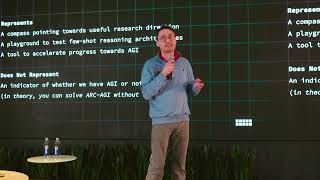
“techniques like um ... program synthesis”

“The central theme of the discussion: generating programs automatically.”
![Tau Language: The Software Synthesis Future [Sponsored] - Ohad Asor](https://img.youtube.com/vi/JVLpxm5jT2s/mqdefault.jpg)
“The process of automatically generating software from logical requirements.”